Some thoughts on cybercrime:
> Conceptually, it is very timely since more and more people are getting connected through the Internet, and thus more and more transactions are being facilitated, perfected and consummated. Most of the time, the parties to the transactions do not even have to meet, see, hear or even speak to each other -- the Internet does all that for them. Thus, with all these cybertransactions taking place, people should have a legal recourse when any of their rights are violated -- especially when the violation is criminal in nature.
>However, here in the Philippines, the primary code which deals with penal offenses is Act No. 3815 or the Revised Penal Code -- of 1930! How archaic can a law get? Evidently, penal acts or omissions were not contemplated then when this code was drafted. Though the main elements of a crime may be present, cybercrimes have certain characteristics which are peculiar to the situation, which in turn makes the provisions of the Revised Penal Code inadequate to address such acts.
Thursday, July 27, 2006


Tuesday, July 11, 2006
conVIRGINS: taste the possibilities
Convergence is the brainchild of innovation. Or sheer boredom.
Don't you just enjoy watching the home tv shopping network? Here's a food processor that slices, dices, peels, crisscuts and mashes. But wait!There's more! You can use it make your favorite egg salad without the hassle of peeling off the shell! All THAT for the low low LOW price of $4.99! The Japanese are an even more amusing lot. Which people in their right mind can think of inventing an umbrella that extends down to the ankles? A person with that same frame of mind also invented the internet.
Don't you just enjoy watching the home tv shopping network? Here's a food processor that slices, dices, peels, crisscuts and mashes. But wait!There's more! You can use it make your favorite egg salad without the hassle of peeling off the shell! All THAT for the low low LOW price of $4.99! The Japanese are an even more amusing lot. Which people in their right mind can think of inventing an umbrella that extends down to the ankles? A person with that same frame of mind also invented the internet.

Originally conceptualized as a defense network in the United States, the internet evolved into usenet groups for sharing information, and further evolved into the state where it is now: a global village, a world unto itself, cyberspace --- where you can do virtually what you do in real life. You can talk to people, order pizza, drive, watch your favorite show, own a pet and even... *gasp* fall in love!
Much like how cultures have a tendency to melt into each other (taglish, bollywood, latino rap, boondocks, michael jackson--he's black, he's white), convergence (in its techie sense) is an interlacing of technologies, --- a blurring of boundaries. New uses have been discovered for seemingly incompatible inventions. Take our favorite topic in class -- VoIP... calls made through phone lines from circuit switched to internet protocol. Revolutionary! Another case in point: p2p file sharing (napster, limewire, gnutella) from exchanging files to downloading bootleg music to a backdoor portal for hacking. Still revolutionary.
With the creation of a virtual world also came the infirmities of the real world--cybercrime. Despite that downside to the shiny concept of convergence, technology still evolves at a rapid pace (don't you just regret buying that laser disc player? Hehe), and its benefits outweigh its disadvantages. With the internet, we see technology imitating life imitating technology. Do you know that scientists say it may be possible for ODORS to be sent through the internet? Now THAT is convergence. Ü
In the immortal words of Madonna..."Like a virgin, touched for the very first time. Like a virgin... when your heart beats, next to mine..."
What has that got to do with CONVERGENCE? Well, nothing really... at least to our knowledge. Who knows, perhaps somewhere, somehow, someone... out of sheer boredom or a flash of inspiration, may know all along.
Tuesday, July 04, 2006
Oops there goes another rubber tree plant
 The UNCITRAL model law, a suggested "pattern" for electronic commerce laws of participating countries, emphasizes the need for wide application and media-neutrality in order to cover all factual situations--- present and future--- wherein the electronic commerce law can apply. This intent is understandable given the rapid rate of growth and obsolescence of technology. However, UNCITRAL's wide application policy may run risks of being vague and overbroad, and thus, may not always facilitate the ease of international transactions.
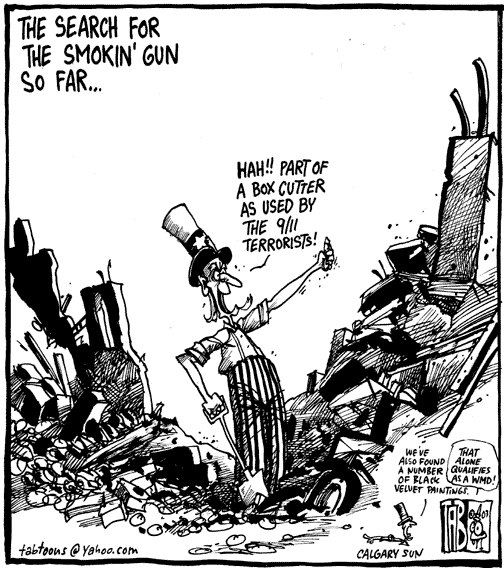
And experience only teaches us that an overbroad law may be distorted in such a way that its application may run counter to its objectives. Case in point: no one expected the United States to take unilateral action on Iraq's alleged weapons of mass destruction, without UN's approval. And yet, in declaring a first-strike policy and adopting preemptive hostile action, the US found loopholes in the law to justify its unprovoked aggression. If the UN Security Council, the body governing international relations regarding force and warfare barely addressed the US' "good faith" interference, then one can hardly blame us for being skeptical about the broad application of the Model Law.
Section 37 of the E-Commerce Act of the Philippines, perhaps in keeping with this wide-application policy, provides for an interpretation which gives due regard to the law's international origin and need to promote uniformity in its application. Given its all-encompassing language, this clause seems to share the same infirmities of vagueness and overbreadth of the Model Law. It is also potentially conflicting, sicne even though it encourages wide application --- thereby espousing uniformity among nations, --- it also acknowledges each country's prerogative in enacting its own laws according to State policy.
The provision regarding the application of general principles of international law is nothing new. Weeks from the start of the first day of class, any freshman law student can tell you that general principles of international law form part of the law of the land. Our fear, unfounded as it may seem, is that we might be sacrificing our own state objectives all in the name of uniformity of application . Perhaps in our haste to conform to international laws, much of our ideals and independence as a nation have been compromised. Moreover, one cannot entirely brush away the pessimism borne of experience, that other countries might not necessarily follow the Model Law, given due regard to locally enacted laws.

There is nothing wrong with the desire to be bridged with legal systems and societies of differing technologies seamlessly, but as a rule, the country's E-Commerce law must be tailor-made to the many peculiarities attendant to its circumstances, and with enough safeguards to be in keeping with international standards as well. The Model Law should therefore, at best, serve as a mere framework for any country.
Anyway, the Electronic Commerce law is relatively new. There is no established jurisprudence yet on the matter. As for now, we can only hope that we don't end up being steamrolled by the objectives of the Model Law.

Monday, June 26, 2006
originality
While surfing, I came across a very interesting and amusing blog entry. To quote it in full:
left behind
_______________
Whoever posted this blog entry probably isn’t the only person who has had this kind of a problem. All over the world, transactions are becoming more and more complex, and yet the actual processing of those transactions take significantly less time than before – all thanks to electronic commerce, more popularly known as e-commerce. Because technology is improving at an amazingly fast pace, in theory, people should be able to transact business with considerable ease… however, as the blog above has shown, there are extant gaps and discrepancies, especially in the implementation of the rules on e-commerce, which prevent business transactions from proceeding in the desired pace.
In this field, the quintessential question has been, “What is an original document?” The concept of originality with respect to documents used to be simple… since there were no copiers back then; every document had to be executed by the person himself – making each and every document an original. Probably during this time, little dispute arose as to whether a document was original or not. When the copier was invented, the concept of originality of a document became more contentious, and distinction was made between the “original” and a mere “copy” of it. This distinction, however, could be easily made, since it can be readily seen whether the document is indeed an original or a copy – the original was written or executed in the “original medium (usually ink, typewriter ribbon), while the copy/ies were either carbon copies, or photocopies (with the birth of the photocopier). It was relatively easy to tell which was which. Now, with electronic documents, the distinction is again, blurred. True, with electronic documents, transacting is made so much easier due to the speed ad convenience it offers, but a problem arises as to originality and authenticity – and as illustrated by the blogger’s dilemma above, it can also hamper commercial transactions.
Originality as a concept may vary. The more common conception of originality is illustrated in the above discussion, which is strict in a sense because there is no flexibility in it; it’s either original or not. Another conception of originality can be as to identity of content. This is the conception used in our Rules of Evidence. The Rules state that “the original of a document is one the contents of which are the subject of inquiry [Rule 131, Section 4(a)]. Given this definition of an “original” document, for evidentiary purposes, a copy can actually be an original, since the basis of originality is the content of the document.
Basically, the problem is that despite advances in technology and communication, specifically in business transactions, the idea of people with respect to what “original documents” are has still not progressed. Yes, the technology is already there, ready and available to be utilised, but its use is not being maximised precisely because of this problem. At this point in time, though there are already laws and Rules recognising and protecting electronic documents, it still does not have the same “trust value” which paper documents possess. When it comes to safety and authenticity, I guess paper documents appeal more to the senses.
What is really needed here is time; time for people to adapt to the idea of totally doing business electronically, with almost no paper transactions.
left behind
I recently submitted some conference expenses for reimbursement. I transmitted the information electronically as the conference program, the airline ticket receipt and the lodging invoice were all electronic. I received a phone call that afternoon:
“I’m sorry, but we need the original documents.”
“These are the original documents.”
“I can’t take copies of conference programs and accounting will not accept these for your lodging and travel. I need the originals.”
“What do you mean?”
“They have to be original.”
“Can you define that? I’m not trying to be difficult but I really don’t know what you need because these are the originals. I don’t have original credit card receipts or anything like that.”
“Well, you’ll have to call the airline and get them to send you something. And this receipt
for the lodging, it needs to be in color or have a signature or something.”
“Ok, I’ll see what I can do.”Later, me on the phone with Northwest Airlines:
“Yes, my institution needs an original receipt for my travel.”
“Don’t you have the e-ticket and receipt we sent you?”
“Yes, but that’s not original enough for them. Can you send me out something in paper?”
“We can but it will be exactly the same document and you will be assessed a fee.”
“Oh screw it. Thanks, though. I think I’ll just print what I have and fold it like it was in an envelope.”
(http://thethirdattempt.blogspot.com/2006/05/left-behind.html; 26
June 2006)
_______________
Whoever posted this blog entry probably isn’t the only person who has had this kind of a problem. All over the world, transactions are becoming more and more complex, and yet the actual processing of those transactions take significantly less time than before – all thanks to electronic commerce, more popularly known as e-commerce. Because technology is improving at an amazingly fast pace, in theory, people should be able to transact business with considerable ease… however, as the blog above has shown, there are extant gaps and discrepancies, especially in the implementation of the rules on e-commerce, which prevent business transactions from proceeding in the desired pace.
In this field, the quintessential question has been, “What is an original document?” The concept of originality with respect to documents used to be simple… since there were no copiers back then; every document had to be executed by the person himself – making each and every document an original. Probably during this time, little dispute arose as to whether a document was original or not. When the copier was invented, the concept of originality of a document became more contentious, and distinction was made between the “original” and a mere “copy” of it. This distinction, however, could be easily made, since it can be readily seen whether the document is indeed an original or a copy – the original was written or executed in the “original medium (usually ink, typewriter ribbon), while the copy/ies were either carbon copies, or photocopies (with the birth of the photocopier). It was relatively easy to tell which was which. Now, with electronic documents, the distinction is again, blurred. True, with electronic documents, transacting is made so much easier due to the speed ad convenience it offers, but a problem arises as to originality and authenticity – and as illustrated by the blogger’s dilemma above, it can also hamper commercial transactions.
Originality as a concept may vary. The more common conception of originality is illustrated in the above discussion, which is strict in a sense because there is no flexibility in it; it’s either original or not. Another conception of originality can be as to identity of content. This is the conception used in our Rules of Evidence. The Rules state that “the original of a document is one the contents of which are the subject of inquiry [Rule 131, Section 4(a)]. Given this definition of an “original” document, for evidentiary purposes, a copy can actually be an original, since the basis of originality is the content of the document.
Basically, the problem is that despite advances in technology and communication, specifically in business transactions, the idea of people with respect to what “original documents” are has still not progressed. Yes, the technology is already there, ready and available to be utilised, but its use is not being maximised precisely because of this problem. At this point in time, though there are already laws and Rules recognising and protecting electronic documents, it still does not have the same “trust value” which paper documents possess. When it comes to safety and authenticity, I guess paper documents appeal more to the senses.
What is really needed here is time; time for people to adapt to the idea of totally doing business electronically, with almost no paper transactions.
Sunday, June 18, 2006
cybercrime
found an interesting read while crawling the web....
"ADDRESSING INTERNATIONAL ENFORCEMENT ISSUES RELATED TO CYBER CRIMES AND CYBER TERRORISM: A CONCERN OF THE PHILIPPINE CENTER ON TRANSNATIONAL CRIME
Directorate for Research,
Philippine Center on Transnational Crime
Camp Crame, Quezon City
During the Second Roundtable Discussion of
"Computer Crime: Problems in National and International Law"
U.P. Law Center Institute of International Legal Studies
Information Technology Law program
August 31, 2000
I. Introduction
The rapid growth of technology, and information technology at that, has created a paradox in society, such that we now have to live side by side with the advances that it has wrought into our lives, as well as the dangers that it poses to man and society. To be able to address the current and future issues and concerns of the ever-changing world in information technology requires more than an afterthought. For no matter how remarkable these advancements have become, there also will always be advancements in criminal undertakings and activities that use the very same technology to "advance" their very own peculiar interests.
The rapid growth of technology, and information technology at that, has created a paradox in society, such that we now have to live side by side with the advances that it has wrought into our lives, as well as the dangers that it poses to man and society. To be able to address the current and future issues and concerns of the ever-changing world in information technology requires more than an afterthought. For no matter how remarkable these advancements have become, there also will always be advancements in criminal undertakings and activities that use the very same technology to "advance" their very own peculiar interests.
No nation in this fast-moving technological arena is spared of this afterthought. The efforts being exerted by each and every nation in combating transnational crimes, particularly computer crimes, have become a crux in each of these nations' security and law enforcement agenda. And the Philippines is no different in this regard.
x x x x x x x x x
III. Addressing International Enforcement Issues Related to Cyber Crimes & Cyber Terrorism
Among the pressing concerns of the PCTC, as well as law enforcement agencies in other foreign countries nowadays, is the state of vulnerability in the field of telecommunications and electronic commerce. Our country, as with other countries, have been witnesses to a host of hostile computer-related attacks in the past few years, some rather incongruous, others just as devastating as the Melissa and the Love Bug viruses. But nothing can prepare us to face future attacks against our information infrastructure systems if at this point in time, specific measures are not exerted in order to address this threat.
What is being perceived by most countries, particularly the highly-developed ones, is the emergence of a newer strain of criminal undertaking that defies boundaries and affects every strata of society. This new threat, cyber-terrorism, is yet to be mentioned and expounded in the legal literature of many countries, but its insidious effects are already being felt even at this time. Cyber-terrorism, which is the convergence of terrorism and cyberspace, can ensue even from a "harmless" intrusion, or hacking, to a full-blown debilitation of a certain country's national information infrastructure system. The focus now, particularly in the field of preemptive measures, is to contain the incidence of cyber-criminal activity from blowing over into a terroristic undertaking.
The United States, Russia, the member-states of the European Union, and even Singapore and Australia, have already taken definitive measures in addressing enforcement issues against cyber-crimes and cyber-terrorism. The Philippines must, in this breadth, take also that next step.
During the recent International Computer Crime Conference in Oslo, Norway, whose theme was "The Internet as Scene of the Crime", the consensus among the multinational participants was to address two specific, significant issues in the area of international enforcement. These are the formulation of a multinational convention to prevent and combat cyber crime and cyber terrorism, much like a United Nations Convention on the Combating of Certain Transnational Crimes and the Council of Europe Draft Convention on Computer Crime, and the national security policies regarding the use of digital encryption technologies and cryptography as a means to protect a nation's information infrastructure system.
Already, the Council of Europe has made significant inroads in conceptualizing a convention to address computer crime, and it just awaits the signature of its member-states for it to become the operational guideline of these countries in dealing with the incidence of computer crimes as it affects both national and transnational jurisdictions.
With the operationalization of the ACTC, the Philippines and its ASEAN counterparts can also initiate the same direction being propounded by the Council of Europe and come up with a regional convention to address the incidence of transnational crimes, to include computer crimes. Hopefully, this idea would not be too late as to ensue only after we, or any of the other ASEAN countries, would have to experience another hostile computer-related attack that would make this effort rather meaningless.
There must also be efforts by us, as well as other ASEAN countries, to take into consideration the significance of utilizing cryptography and digital encryption as a national security policy, if only to protect our own information infrastructure systems, as well as detect, monitor, and deny hostile computer attackers of their activities, and lead to their identification and eventual arrest and prosecution. The United States, and other Western nations, have realized the importance of this aspect as a significant portion of their national security agendas, and we, too, should heed the route they are going to.
For now, the Philippines will have to do with the enactment of Republic Act 8792 , also known as the Electronic Commerce Law, but, by itself, the weapons we need to address the foreboding threats of cyber crime and cyber terrorism may not be enough."
full article here.
Subscribe to:
Posts (Atom)